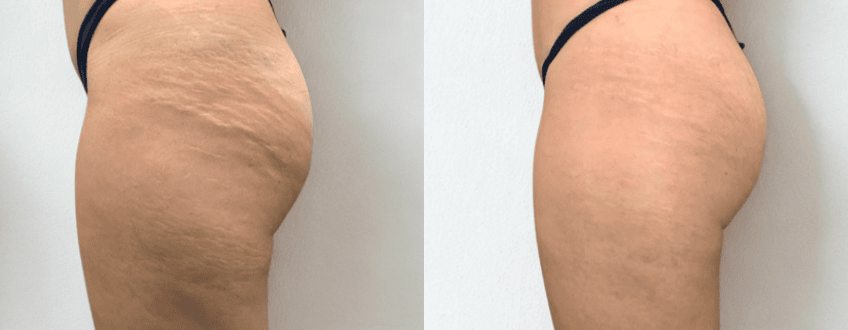
Stretch marks and scars carry not just a physical presence on the skin but also emotional weight. Many people live with these marks for years, feeling self-conscious or restricted in how they dress or move. At Belle Âme Skin & Beauty Lounge, we offer a treatment that goes beyond covering. Our inkless camouflage revision for stretch marks and scars leverages the body’s natural regenerative processes to restore skin texture and improve tone in a way that feels subtle and effective.
This is not tattooing. Instead, it is a regenerative therapy using controlled micro-injury along with deeply absorbed serums to stimulate collagen, elastin, and longer-term structural healing.
Inkless Camouflage | A Regenerative Path to Improving Stretch Marks & Scars
Revitalizing Skin Naturally
Why Stretch Marks & Scars Can Appear Highly Visible, Even Without Losing All Melanocytes
Understanding the process begins with understanding what makes stretch marks and scars look the way they do.
Dermal Architecture Disruption
- →When skin is rapidly stretched (pregnancy, weight fluctuation) or injured (surgery, trauma), the dermis (the skin’s middle layer) is torn. Collagen and elastin fibres are disrupted, reducing structural support.
- →Over time, this results in atrophy (loss) of dermal tissue, and often the overlying epidermis thins out. The result? Skin that feels less dense and appears more translucent in the marked areas.
Melanocyte Distribution vs. Loss
- →Contrary to a common misconception, many stretch marks and certain scars retain their melanocyte (pigment cell) population. They may not have been destroyed. Instead, they’re spread thinly or functioning in a less supported microenvironment.
- →Because the dermal structure is altered, the marks can look lighter, more silvery, or “washed out” relative to surrounding skin. Not necessarily because the pigment is gone, but because the skin itself lacks the scaffold to display it normally.
Contrast, Not Just Color
- →The contrast between the stretch mark or scar and the surrounding skin is often due to structural and optical differences: thin dermis, lower collagen density, and uneven vascularization.
- →By restoring the dermal architecture, you change how light interacts with the area, reducing that contrast, which helps visually “blend” the mark into the surrounding skin.
KEY INSIGHT
Because of this, Our goal isn’t to create new melanocytes or paint over the area; it’s to rebuild what’s underneath, supporting natural pigment and improving texture so the mark is less noticeable from within.
What Exactly Is Inkless Revision?
A medically informed, aesthetic-regenerative service. The key components are:
- →Micro-injury via Needling (Collagen Induction Therapy)
- →Deposition of Regenerative Serums (instead of pigment)
- →Stimulation of Dermal Healing and Remodelling
Here’s a breakdown of how it works:
Controlled Micro-Injuries
- →We use a microneedling or similar device to create tiny channels in the epidermis and into the upper dermis. These micro-injuries are carefully controlled in depth and density.
- →These channels are not meant to scar but to trigger a healing cascade. Fibroblasts. The skin’s collagen-producing cells are activated, and growth factors are released.
Serum Infusion
- →Immediately after needling, we apply a specially formulated serum into those micro-channels. This serum is rich in active ingredients like peptides, growth factors, vitamin C, and hydrating agents instead of traditional tattoo ink.
- →The serum works to support fibroblast activation, encourage collagen and elastin production, and optimize the healing microenvironment.
Healing & Remodeling
- →Over weeks and months, the micro-injury stimulates the skin’s natural wound-healing process: first inflammation, then proliferation, then remodeling.
- →New collagen (especially types I and III) and elastin are laid down, and existing tissue becomes denser and more uniform.
- →The result is improved texture, thicker dermis, and better tone match between the treated mark and surrounding skin.
Real-World Experience & Client Feedback
While scientific studies give us confidence, real client experiences are also powerful. Anecdotal evidence from people who’ve undergone “inkless” or micro-infusion camouflage suggests:
- →Some clients report noticeable softening of stretch mark color and texture after a few sessions. (Reddit)
- →Others note that their raised or pigmented scars become flatter, smoother, and more similar in tone to surrounding skin. (Reddit)
- →There are mixed reviews: some people caution about downtime (redness, soreness) and emphasize the need for 3+ sessions to see meaningful change. (Reddit)
- →Importantly, informed providers stress realistic expectations, improvement, not complete erasure, especially for older or more severe marks. (Reddit)
These client voices align well with the underlying biology: regeneration takes time, and multiple treatments plus careful aftercare are often required to get the best results.
Why Inkless Is a Smart Option (Especially for Stretch Marks & Scars)
Here are key reasons why this approach is particularly attractive and effective:
Natural & Subtle Outcome
- →Because the method relies on natural remodelling rather than pigment implantation, the results are more organic.
- →There’s less risk of mismatched tone or fading pigment over time, which can happen with traditional camouflage tattooing.
Lower Risk Profile
- →The regenerative approach (needling + serum) is minimally invasive.
- →Because no heavy pigment is used, the risk of long-term discoloration is reduced.
- →Healing typically involves some redness but is less aggressive than ablative lasers.
Long-term Skin Health
- →By improving dermal quality (collagen, elastin), you’re not just hiding a mark. You’re improving the skin’s resilience, elasticity, and structure.
- →The skin becomes healthier at a foundational level, which may also support better responses in future treatments or prevent further degeneration.
Customizable Treatment
- →You can tailor the depth of needling, the type of serums used, and number of sessions to match the client’s mark severity, skin type, and goals.
- →This makes the service versatile and client-centred.
Supports Skin’s Own Healing
- →The body’s wound healing pathways are leveraged, not bypassed. This regenerative process is natural and gradual, making the results feel more “real” and integrated.
Why the Regenerative Approach Works: Backed by Science
Collagen Induction Therapy (Microneedling): The Foundation
Microneedling, also called percutaneous collagen induction (PCI), is the backbone of inkless camouflage. It has well-documented regenerative effects:
- →A comprehensive review of PCI for scars and photoaged skin found consistent evidence of skin remodelling, increasing collagen and elastin, and clinical improvement in scar quality. (PubMed)
- →In one study involving four microneedling sessions spaced monthly, researchers observed a 400% increase in collagen and elastin deposition at six months. (NCBI)
- →Ethical pilot studies on burn scars have shown that microneedling can transform the collagen architecture, turning immature collagen (type III) into strong, mature collagen (type I), while also promoting new blood vessel formation and reducing scar quality. (PubMed)
- →In a controlled histological evaluation of acne scars, microneedling produced a significant increase in collagen types I, III, and VII, as well as more dermal papillae and a thicker epidermis over several months. (JCAD)
Regenerative Adjuncts Amplify the Effect
- →A pilot clinical study of autologous micrografting + microneedling in 14 people with stretch marks showed not only visible improvement, but also upregulated genes involved in extracellular matrix (ECM) production: COL4A1, COL6A1 (types of collagen), and ELN (elastin). (PubMed)
- →Another study combined microneedling with a diluted calcium-hydroxylapatite (CaHA) filler plus 20% topical ascorbic acid (vitamin C). Biopsies revealed improved quantity and quality of collagen and elastin fibers in the treated stretch-mark areas. (PubMed)
- →A regenerative strategy using microneedling + platelet-rich plasma (PRP) or mesenchymal stem-cell (MSC) conditioned medium has been studied in stretch marks (striae). One such study found significant gains in dermal thickness, density, and patient satisfaction when MSC medium was used along with needling. (BioMed Central)
These studies support the theory behind serum based camouflage: you don’t need ink to improve a mark. You need structural regeneration.
All of this indicates that micro-injury reliably engages the body’s natural remodelling processes, exactly what we want when doing inkless camouflage.
Who Is This Service For?
This service is appropriate for a wide range of clients seeking a safe, comfortable, and results-focused experience.
Step-by-Step Protocol
Consultation & Assessment
- →Evaluate each client’s stretch marks or scars in terms of color (red, purple, white), depth, width, and skin type.
- →Explain the treatment plan: needling + regeneration, not ink covering.
- →Set expectations: how many sessions may be required (commonly 2–4), expected downtime, and realistic outcomes.
Pre-Treatment Preparation
- →Recommend a home-care pre-treatment regimen (e.g. vitamin C serum, peptides, gentle hydrators) for 2–4 weeks to prime the skin.
- →Advise avoiding aggressive actives (strong retinoids, acids) and sun exposure in the weeks before treatment.
Treatment Session
- →Use a tattoo machine or micro-infusion device at a depth optimized for the client’s skin and mark (often tailored to 1.0–2.5 mm depending on location).
- →Infuse a specialized regenerative serum through the micro-channels: this may include peptides, growth factors, antioxidants, and hydrating agents.
- →After treatment, soothe the skin with calming masks or gels, and apply a barrier product to support healing.
Aftercare
- →Give clients a clear aftercare protocol: use gentle cleansers, avoid sun exposure, apply recommended serums and moisturizers, and use SPF daily.
- →Advise on expected recovery: redness and mild swelling for 24–72 hours, potential micro-crusting, gradual healing.
- →Schedule follow-up sessions every 8–12 weeks depending on healing and response.
Maintenance
- →Recommend a long-term homecare routine (vitamin C, growth-factor serums, peptides) to support ongoing remodeling.
- →Offer “touch-up / refinement” sessions at intervals (e.g., every 6–12 months) to sustain improvements.
- →Document progress with before/after photos to monitor structural improvements and guide future treatments.
BELLE AME · VANCOUVER
Discover Belle Âme Beauty
Regaining confidence and embracing your natural skin is just a consultation away. At Belle Ame Skin and Beauty Lounge, we provide professional treatments for stretch marks and scars in Vancouver, BC.
Discover Belle Âme Beauty
About Us
Belle Ame Skin and Beauty Lounge in Vancouver, BC, specializes in advanced skin treatments like camouflage tattoos, inkless camouflage, permanent makeup, and custom lash and brow treatments. Our expert technicians provide personalized care in a relaxing environment, helping you achieve healthy, glowing skin. Whether you’re looking to enhance your natural beauty or address specific skin concerns, we’re here to support you on your skincare journey.
Get In Touch
2941 Kingsway, Vancouver, BC V5R 5J2
+1 (778) 238 9305
[email protected]
Monday – Sunday 9:30 AM – 7:00 PM Closed on Holidays
Have a Question?
Feel free to ask us any questions you may have. We’re here to help and provide the information you need. Don’t hesitate to reach out – we’re happy to assist.
Follow Us
Recent Posts